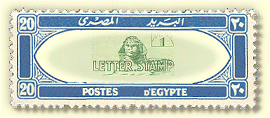
Overview: This section is devoted to the study of military postal history in Egypt. It consolidates the Circle’s displays on the Army Post and British Forces, covering a wide historical range.
Here you will find postal history ranging from the early Napoleonic era and the British Occupation of 1882—represented by rare surviving covers—through to the complex Army Post systems established in later years.
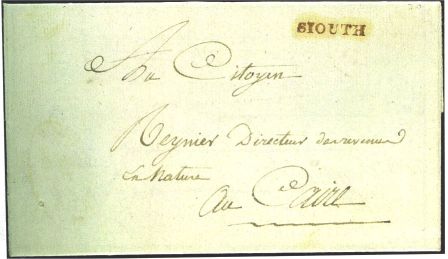
Cover with Siouth (Assiout) marking of the Napoleonic Army in Egypt 1798 - 1801.
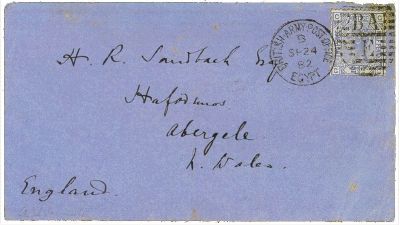
1882 British Army Post Office Egypt with killer BA/E.
In 1932 Egypt increased its internal postal rate from 10 millièmes to 15 millièmes. To assist British troops, an agreement was reached between the War Office and the Egyptian authorities for a concessionary rate. Introduced on November 1, 1932, it applied only to letters to Britain and the Irish Free State.
How it worked: "Seals" were sold over the counter at NAAFI canteens to Forces members only. These were to be stuck on the back of the envelope and cancelled by a retta handstamp.
Nov 1932: The original "postal seal".
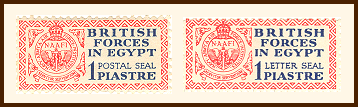
Aug 1933: Replaced with a similar "letter seal".
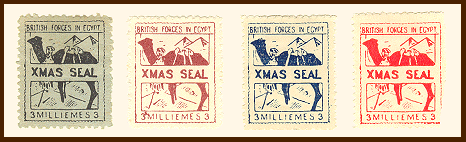
At Christmas and New Year special "Xmas seals" were produced from 1932 through to 1935. A new design was issued on January 1, 1934, with the words "LETTER STAMP" now incorporated.
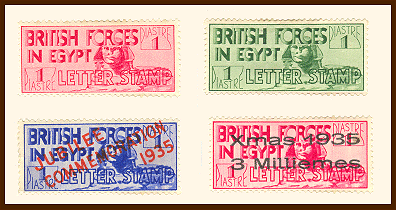
The franking power was in the crown handstamp placed on the face of the cover. This was normally in red but is also found in blue.


Needless to say, letters bearing the Army seal and stamps were not always used as intended.
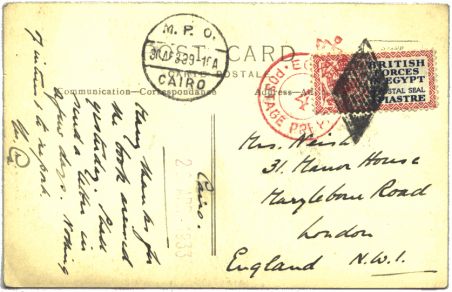
Naafi Postal Seal: Used on the front of a postcard contrary to regulations.
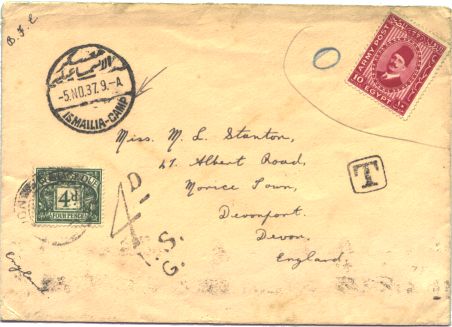
Army stamps were for use only through military channels. The cover here has been posted into a normal civilian postbox, hence the postmark of Ismailia Camp.
It therefore received the 'O' marking showing that the stamp was invalid for use. Subsequently, it received the boxed [T] in Egypt and a postage due stamp in England for 4d, double the postage rate of 10 millièmes (equal to 2d).
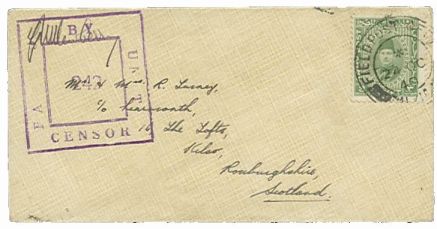
The small 3 millièmes stamp was brought out for the concessionary rate for Christmas in October 1940.
However, free postage was implemented soon after, making its use redundant. Only a few covers were posted early, making its genuine use on cover quite rare.

© Egypt Study Circle